
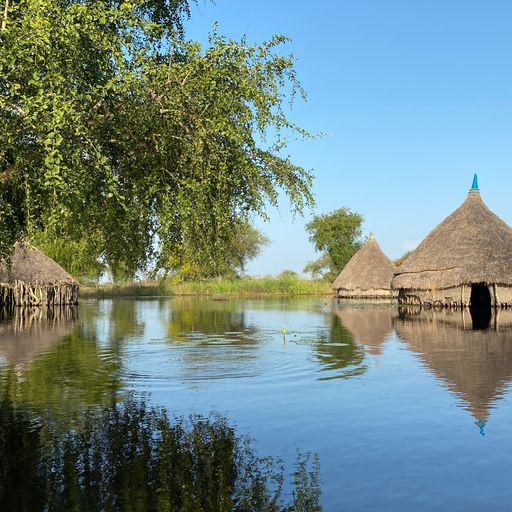
South Sudan’s rain comes by the season. Summertime is wet; winter sees hardly any rainfall. This year, the rain stopped in October as usual, but the river kept on rising.
That much water was unprecedented, and unreal. Five years ago we had flooding, but this year was different. The river kept rising even when the rains stopped. By December, Old Fangak and the surrounding land lay lower than the bloated river. No one could tell us why this would happen during the dry season.
Old Fangak’s only defense was to build dikes—by hand. You poke a small tree trunk into the muck, and use it as a shovel to raise up a narrow serpentine wall around whatever you need to protect. Then, bucketful after bucketful, you move water to the other side.
The community of Old Fangak built their biggest dikes ever. Often that meant an inner wall to protect homes when the outer wall collapsed. Gunshots in the night mean that a dike has broken. People stream out to rebuild it before water carries too much of their hard work away.
One day, the whole village of Wangchot showed up in Old Fangak. They had already relocated to higher ground and surrounded it with dikes. When a rush of water tore down their dikes and left nowhere dry to sleep, they moved en masse to Old Fangak, where the dikes were still holding.
The population of Old Fangak has mushroomed when people are displaced by fighting, but never before by flooding. At one point, 80% of our outpatient visitors were water refugees.
The silver lining in this cloud was that entrepreneurs, especially kids, could row passengers from one diked area to the next, sometimes for days at a time. Floodwaters also provided more fish, just in time for the so-called hunger gap. “Hunger gap” is the sanitized term for when food runs out before the harvest comes in.
Sadly, food ran out just a couple months after the harvest that wasn’t. Rains destroyed 80% of the crop. Then rising waters washed away the rest.
Although the World Food Program was recognized with the Nobel Peace Prize last year, its budget was slashed in 2021 due to COVID. Food allocations for TB, kala azar, and HIV decreased by a third. We are so grateful for your unrestricted donations, which allow us to buy tons of sorghum, a dietary staple, imported from Sudan.